


跳转到主要内容
搜索

Targeted Radionuclide Therapy (TRT) and Theranostics

Optimize Dose, Dosimetry, and Decisions with Model-Informed Radiopharmaceutical Development Strategies

Accelerate confident radiopharmaceutical development from early translation through submission

Targeted radiopharmaceuticals are transforming oncology, but TRT development is fundamentally different. Many programs are developed as theranostic pairs, where imaging agents guide patient selection, biodistribution, and treatment decisions.

Sponsors must make high-stakes decisions early, defining injected activity, mass dose, fractionation, and therapeutic index, while managing dual PK, imaging-based biodistribution, and increasing regulatory expectations.

Successful radiopharmaceutical development is determined before first-in-human (FIH)

Model-informed approaches enable confident early decisions, supporting target selection, defining a clear Target Product Profile (TPP), and optimizing dose strategy to reduce late-stage risk and strengthen regulatory confidence for targeted radiopharmaceuticals, radioligands, and radioconjugates.

Sponsors must manage:

  • Dual PK (targeting vector and radioactivity)
  • Imaging-based biodistribution
  • Organ absorbed dose
  • Biologically effective dose

At the same time, regulatory expectations are increasing. Dose optimization is no longer optional; it is a core requirement shaping FDA and EMA interactions today.

Dose strategy is now a regulatory and competitive differentiator in radiopharmaceutical development

Without clear demonstration early, programs risk delays, rework, and limited label flexibility, making early decisions critical to achieving speed, differentiation, and regulatory confidence.

Regulators increasingly expect:

Evidence-driven dose and regimen selection
Integrated biodistribution and dosimetry analysis
Quantitative exposure–response relationships
Clear justification of fractionation and cumulative activity

Integrated capabilities for radiopharmaceutical development

One partner delivering a unified MIDD strategy, integrating mechanistic and empirical modeling across the radiopharmaceutical development lifecycle from early translation through regulatory strategy and submission support.

QSP Modeling

Integrates target expression, binding, and internalization with dosimetry and radiation modeling to quantify organ and tumor absorbed dose, and to predict biodistribution, tumor uptake, and therapeutic index

了解更多信息

定量药理学

Applies biodistribution population PK and exposure–response modeling to optimize dosing, inform key development decisions, and deliver regulatory-ready evidence

了解更多信息

Submission readiness

Aligns modeling with FDA and EMA expectations, defining context of use, ensuring model credibility, and delivering submission-ready evidence supporting INDs, NDAs, BLAs, and global approvals.

了解更多信息

A model-informed approach to radiopharmaceutical development

In targeted radionuclide therapy and targeted radiopharmaceutical development, MIDD integrates biodistribution, dosimetry, and clinical data into a unified strategy.

This approach supports:

  • First-in-human dose selection
  • Optimization of injected activity, mass dose, and fractionation
  • Prediction of tumor uptake and organ radiation exposure
  • Quantitative exposure–response relationships
  • Defensible dose justification for submission readiness

This integrated approach enables teams to move from data collection to decision-making with confidence, reducing uncertainty across radiopharmaceutical development.

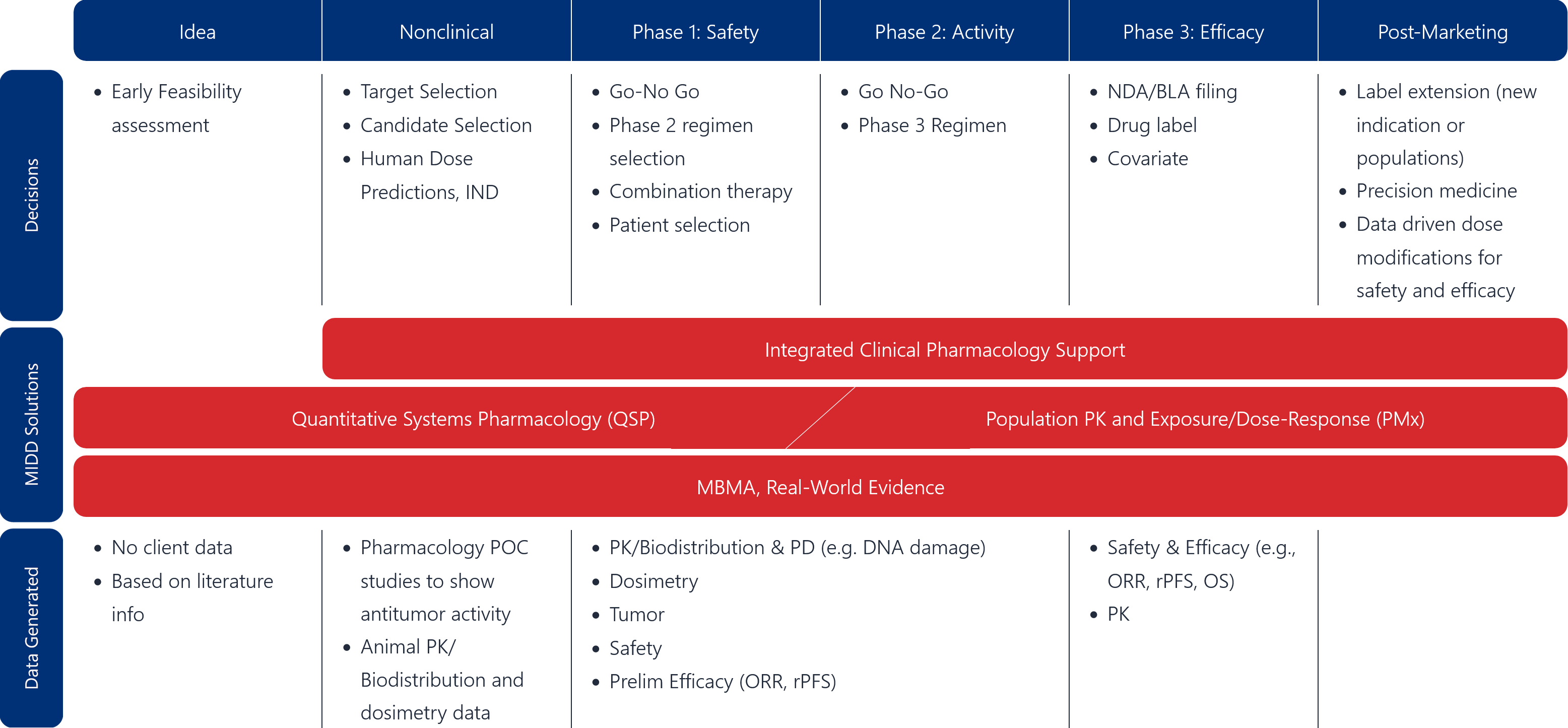
Idea

Nonclinical

Phase 1: Safety

Phase 2: Activity

Phase 3: Efficacy

上市后

  • Early Feasibility assessment​
  • Target Selection​
  • Candidate Selection​
  • Human Dose Predictions, IND
  • Go-No Go​
  • Phase 2 regimen selection​
  • Combination therapy​
  • Patient selection​
  • Go No-Go​
  • Phase 3 Regimen​
  • NDA/BLA filing​
  • Drug label​
  • Covariate​
  • Label extension (new indication or populations)​
  • Precision medicine​
  • Data driven dose modifications for safety and efficacy​

Integrated Clinical Pharmacology Support​

定量系统药理学 (QSP)

Population PK and Exposure/Dose-Response (PMx)​

MBMA, Real-World Evidence​

  • No client data​
  • Based on literature info​
  • Pharmacology POC studies to show antitumor activity​
  • Animal PK/Biodistribution and dosimetry data​
  • PK/Biodistribution & PD (e.g. DNA damage)​
  • Dosimetry​
  • Tumor​
  • Safety​
  • Prelim Efficacy (ORR, rPFS)​
  • Safety & ​Efficacy (e.g., ORR, rPFS, OS)​
  • PK​

Turn radiopharmaceutical development complexity into regulator-ready evidence

Certara brings integrated expertise across clinical pharmacology, QSP, PBPK, pharmacometrics, and regulatory strategy to deliver end-to-end model-informed drug development (MIDD) solutions for targeted radiopharmaceuticals and targeted radionuclide therapies.

We help teams:

  • Combine imaging and therapeutic data into theranostic strategies
  • Integrate biodistribution, dosimetry, and clinical pharmacology
  • Apply QSP and pharmacometrics to de-risk decisions across the development lifecycle
  • Predict tumor uptake and organ radiation exposure
  • Optimize dose, regimen, and fractionation
  • Enable confident regulatory interactions and submission-ready evidence

When to engage Certara for radiopharmaceutical development

Assessing target feasibility and target selection
Transitioning from preclinical to IND
Designing dose escalation or expansion studies
Interpreting biodistribution and dosimetry data
Preparing for regulatory interactions
Differentiating in competitive TRT landscapes

Model-informed strategies for radiopharmaceutical development

Certara helps radiopharmaceutical development teams move beyond descriptive analysis with integrated model-informed strategies that support confident development and regulatory decisions

We help sponsors:

  • Guide target selection and FIH dose strategy
  • Translate biodistribution and dosimetry into actionable insights
  • Optimize activity, regimen, and fractionation strategies
  • Balance tumor efficacy with organ safety
  • Integrate clinical pharmacology and regulatory strategy early
  • Build regulator-ready evidence across development lifecycle stages
Contact an TRT expert
20
Years of oncology drug development experience, targeted radioligands and dosimetry experience
20
Helped >20 tRPs assets navigate the new requirements in the past 3 years
9
Clinical pharmacologists, DMPK specialists and modelers on our Radioligand Therapies Team

Advance your radiopharmaceutical development program with confidence

Whether defining your first-in-human dose, evaluating biodistribution and dosimetry, optimizing treatment strategy, or preparing for regulatory interactions, Certara helps targeted radionuclide therapy (TRT) and theranostics teams reduce uncertainty and make confident, model-informed development decisions.
We help teams

Support translational dose selection and escalation strategies
Optimize dose, regimen, fractionation, and therapeutic window
Characterize biodistribution, dosimetry, and exposure–response relationships
Apply PBPK, QSP, and pharmacometrics modeling to targeted radiopharmaceutical development
Build submission-ready evidence aligned with evolving FDA and EMA expectations

常见问题解答

What is radiopharmaceutical development and targeted radionuclide therapy (TRT)?

Radiopharmaceutical development and targeted radionuclide therapy (TRT) use radioactive isotopes linked to targeting molecules to selectively deliver radiation to tumors while minimizing exposure to healthy tissue. Many targeted radiopharmaceuticals are developed as theranostic pairs, combining imaging and therapeutic agents.

Why is modeling important in radiopharmaceutical development and TRT development?

Radiopharmaceutical development and TRT development involve complex decisions around biodistribution, dosimetry, therapeutic index, fractionation, and organ toxicity. Model-informed approaches help sponsors optimize dose strategies, predict tumor uptake, and generate regulatory-ready evidence earlier in targeted radiopharmaceutical development.

How does Certara support radiopharmaceutical development and TRT programs?

Certara integrates Quantitative Systems Pharmacology (QSP), Pharmacometrics, PBPK, dosimetry, and regulatory strategy to support radiopharmaceutical development and targeted radiopharmaceutical development from target selection through submission readiness.

What challenges can modeling help address in radiopharmaceutical development?

Model-informed approaches can help address key challenges in radiopharmaceutical development and targeted radiopharmaceutical development, including:

  • First-in-human dose selection
  • Biodistribution and dosimetry interpretation
  • Fractionation optimization
  • Tumor versus organ radiation exposure balancing
  • Exposure-response characterization
  • Regulatory dose justification
  • Competitive differentiation and label strategy

How does imaging support targeted radiopharmaceutical development and theranostics?

Imaging agents support targeted radiopharmaceutical development and theranostic development by helping characterize biodistribution, assess target engagement, support patient selection, estimate absorbed dose, and guide therapeutic decisions throughout development.

When should sponsors engage Certara for radiopharmaceutical development support?

Sponsors benefit most from engaging early in radiopharmaceutical development and targeted radiopharmaceutical development programs, particularly during:

  • Target selection and TPP definition
  • Preclinical-to-clinical translation
  • IND preparation
  • Dose escalation study design
  • Regulatory interaction planning
  • Expansion strategy optimization

沪ICP备2022021526号

Powered by Translations.com GlobalLink Web Software