


 Hunter Stephens, PhDAssociate Director, Pharmacometrics
 Joshuaine GrantSenior Director, Quantitative Systems Pharmacology (QSP)
 Amandine Manon, PharmDSenior Director, Clinical Pharmacology and Translational Medicine
 Mirjam Trame, PharmD, PhDVice President, Certara Drug Development Solutions, Head of Pharmacometrics USA – Division II
 Diane-Charlotte Imbs, PharmD, PhDDirector Clinical Pharmacology, Drug Development Solutions
2026 年 8 月 13 日
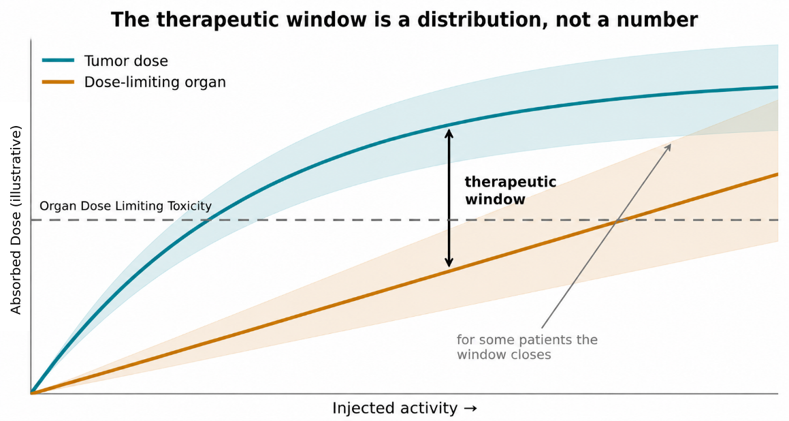
QSP characterizes how tumor and dose-limiting organ exposure rise with injected activity and how the resulting therapeutic window varies across patients and target expression levels.

Looking beyond dosimetry
Project Optimus requires more than absorbed dose calculations. In our upcoming webinar, Certara experts show how clinical pharmacology, pharmacometrics, QSP, PBPK, dosimetry, and regulatory strategy work together to help sponsors optimize dose selection and build stronger evidence packages for therapeutic radiopharmaceutical development.
The defensible dose framework
Six questions the evidence should answer
- Absorbed dose and biologically effective dose, informed by radiobiology rather than gray alone.
- Organ constraints derived for the molecule, isotope, and dose rate, not extrapolated from external beam radiotherapy.
- The uptake and biodistribution mechanism tested against data, not assumed from target expression.
- Therapeutic index and dose–response characterized across patient heterogeneity and variable target expression.
- For α-emitters, explicit and justified assumptions for how decay daughters redistribute.
- Imaging, PK, dosimetry, and mechanism integrated into one exposure–response narrative.
Hunter Stephens, PhD
Associate Director, PharmacometricsHunter Stephens, PhD, is an Associate Director in the Pharmacometrics group at Certara. He specializes in applying mathematical and computational models to understand the pharmacokinetics and pharmacodynamics of drugs, especially radiopharmaceuticals. He has a PhD in Medical Physics from Duke University. He also holds an MS in Physics from North Carolina State University and a BS in Mathematics from Tennessee Tech University. His work in TRT has focused on building semi-mechanistic population PK models to simulate and predict absorbed and biologically effective doses to inform dose-range finding and questions of safety and efficacy. In addition, he has extensive experience in radiation dosimetry from external and internal sources.
Joshuaine Grant
Senior Director, Quantitative Systems Pharmacology (QSP)Joshuaine Grant is a Senior Director in Quantitative Systems Pharmacology at Certara with more than 25 years of experience integrating biophysics, disease biology, and quantitative modeling to advance drug development. She leads collaborative projects that use mechanistic and translational QSP modeling to inform key decisions from discovery through the clinic. Her broad experience across biologics and complex therapeutics has supported Certara’s growing leadership in radioligand and targeted radiotherapies.
Amandine Manon, PharmD
Senior Director, Clinical Pharmacology and Translational MedicineAmandine joined Certara in 2020. She served as a Clinical pharmacologist in several pharmaceutical companies for 15 years. She has a proven track record in preclinical and clinical PK, clinical pharmacology with a special focus on oncology, drug development from early stages to Phase 3, and regulatory experience. Amandine graduated as a PharmD from Paris University, France and she also holds a Master’s degree in Pharmacokinetics.
Mirjam Trame, PharmD, PhD
Vice President, Certara Drug Development Solutions, Head of Pharmacometrics USA – Division IIMirjam is an expert in pharmacometrics and oncology drug development, serving as Head of Pharmacometrics USA – Division II at Certara Drug Development Solutions. With expertise spanning complex biologics, she supports exposure-response analysis, dose and study optimization, and regulatory strategy, with a special focus on radiotherapeutics and cell and gene therapies.
Diane-Charlotte Imbs, PharmD, PhD
Director Clinical Pharmacology, Drug Development SolutionsDr. Diane-Charlotte Imbs is a Director in Clinical Pharmacology at Certara. She joined Certara in 2020 and has been supporting several projects (mAbs, radiopharmaceuticals, small molecules, ADC, fixed-dose combinations) from Phase I to Phase III in rare diseases, hematology, oncology, and post-marketing in cardiology. Before joining Certara, she spent 3 years at Ipsen as a clinical pharmacology project manager where she supported several Phase I projects in oncology (radiopharmaceuticals, small molecules). Diane-Charlotte is a pharmacist by training with a master’s degree in pharmacology and a PhD in Clinical Pharmacokinetics (University of Toulouse, France).
常见问题解答
Does Project Optimus apply to radiopharmaceuticals and targeted radionuclide therapy?
可以。In August 2025, the FDA’s draft guidance on dosage optimization formally brought therapeutic radiopharmaceuticals under Project Optimus. In practice, this means sponsors are expected to justify dose and regimen decisions using the totality of available evidence—dosimetry, pharmacokinetics, biodistribution, imaging, efficacy, and safety—rather than relying on tolerability or maximum tolerated dose (MTD) alone.
Why can’t organ dose limits from external beam radiotherapy (EBRT) be applied to radioligand therapy?
Because dose rate matters. EBRT delivers a high dose over a short period, whereas radioligand therapies deliver radiation gradually over days, giving healthy tissue additional time to repair. As a result, the same absorbed dose can produce a different biologically effective dose (BED), and the deviations vary by organ—so a single EBRT-derived correction factor does not hold across tissues.
What is the difference between absorbed dose and biologically effective dose (BED) in TRT?
Absorbed dose measures the energy deposited in tissue, while BED accounts for how that dose is delivered over time and the biological repair that occurs between and during exposures. For radioligand therapies delivered slowly over days, BED often provides a more meaningful basis for setting organ constraints and relating exposure to efficacy and toxicity than absorbed dose alone.
How does QSP modeling support dose optimization for radioligand therapies?
Quantitative systems pharmacology (QSP) integrates target expression, binding, internalization, biodistribution, and radiation dosimetry to characterize tumor and organ exposure, therapeutic index, and dose response across diverse patients. Because it captures the underlying targeting biology, QSP modeling can test mechanistic hypotheses against data and show how the therapeutic window shifts as target expression changes between patients and over successive treatment cycles.
Do alpha-emitting therapies such as ²²⁵Ac require different dosimetry considerations?
可以。For alpha-emitters, absorbed dose depends not only on the kinetics of the radioligand but also on how radioactive decay daughters redistribute after they are liberated from the ligand. Mechanistic and QSP models can represent each decay daughter as a distinct species with its own kinetics, making assumptions about daughter redistribution explicit and testable rather than hidden inside a single absorbed-dose estimate.
Ready to build a stronger dose optimization strategy?
Whether you’re planning a first-in-human study, optimizing a dosing regimen, or preparing for regulatory interactions under Project Optimus, Certara’s integrated team of experts can help you build a scientifically defensible evidence package.

Sources
1. FDA. Oncology Therapeutic Radiopharmaceuticals: Dosage Optimization During Clinical Development. Draft Guidance for Industry, August 2025.
2. Commentary on the FDA radiopharmaceutical dosing guidance — dose justification and integration of dosimetry and PK/PD data (Targeted Oncology, 2025); Response to the FDA Dosage Optimization Draft Guidance for Radiopharmaceutical Therapies, J Nucl Med (2026).
3. Wahl RL, et al. Normal-Tissue Tolerance to Radiopharmaceutical Therapies, the Knowns and the Unknowns. J Nucl Med. 2021;62(Suppl 3):23S.
4. Hope TA, Hofman MS, et al. Rethinking Dosimetry: The Perils of Extrapolated EBRT Constraints to Radionuclide Therapy (editorial), J Nucl Med (2024).
5. Liubchenko G, et al. Image-based dosimetry for [225Ac]Ac-PSMA-I&T therapy and the effect of daughter-specific pharmacokinetics. Eur J Nucl Med Mol Imaging (2024). doi:10.1007/s00259-024-06681-2.
6. Rupp NJ, Umbricht CA, Pizzuto DA, et al. First Clinicopathologic Evidence of a Non–PSMA-Related Uptake Mechanism for 68Ga-PSMA-11 in Salivary Glands. J Nucl Med. 2019;60(9):1270–1276.
7. Julian W, et al. Searching for Protein Off-Targets of Prostate-Specific Membrane Antigen-Targeting Radioligands in the Salivary Glands. Cancer Biother Radiopharm. 2024. doi:10.1089/cbr.2024.0066.
8. Salivary Gland Toxicity of PSMA Radioligand Therapy: Relevance and Preventive Strategies. J Nucl Med (2018);59(8):1172.
9. Source posters (Certara, SNMMI): “Translating Targeted Radiotherapies from Mouse to Human Using QSP: A Pluvicto Case Study” (S. Minucci, B. Koirala, B. Lang, J. Nosbisch, J. Grant); “Population Pharmacokinetic Modeling to Predict Absorbed and Biologically Effective Dose for Radioligand Therapies” (H. Stephens, A. Manon, M. N. Trame). (Certara, ASCPT 2026) “Quantitative systems pharmacology model of a targeted radiotherapy to inform a target candidate profile and aid in early decision-making” (S. Minucci, B. Koirala, B. Lang, J. Nosbisch, J. Grant)