

跳转到主要内容
搜索

早期可行性评估

QSP Modeling for Biologics Discovery

Better early-stage decisions start with mechanistic insight

Early-stage biologics discovery is filled with big decisions with substantial uncertainty.

Despite limited data, Teams must choose:

  • Which targets to pursue
  • Which candidates to prioritize
  • What properties to optimize
  • Which programs deserve continued investment

Certara’s discovery-stage mechanistic modeling supports target identification and validation in drug discovery, alongside molecular design requirements based on the pharmacological concept with little to no data required.

These early evaluations of biotherapeutic design enable more confident go/no-go decisions by defining optimal drug properties for the intended mechanism of action and identifying developability risks. The quantitative framework supplements intuition and limited experimental data to enrich a pipeline with viable assets through better decision-making.
What is Early Feasibility Assessment?

Early Feasibility Assessment (EFA) is a workflow designed for the earliest stages of biologics discovery, to answer a fundamental pharmacology question: Can a drug work as intended in vivo?

Using inputs derived from literature or early in vitro data, EFA uses mechanistic pharmacology models to predict what design properties a biologic must have to achieve efficacious binding at a relevant site of action in the human body. Such simulations can be used to triage targets, support lead optimization in drug discovery, and prioritize early portfolios, even before a single molecule is synthesized.

The impact: more efficient resource allocation, accelerated development timelines, and reduced late-stage failure, ultimately delivering novel treatments to patients faster.

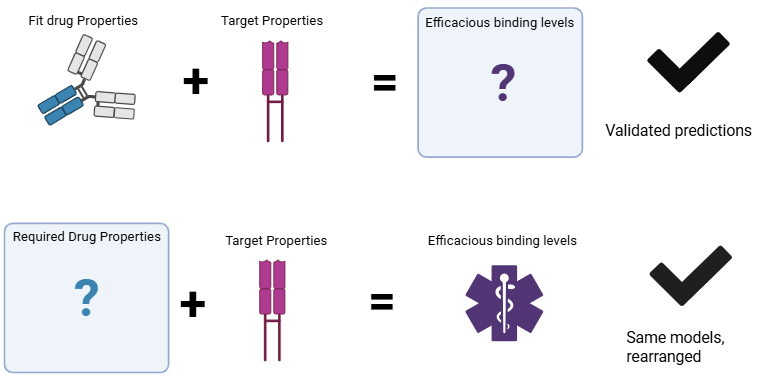
Diagram showing two modeling approaches: the first combines known drug properties and target properties to predict efficacious binding levels, yielding validated predictions; the second rearranges the same models to determine required drug properties from known target properties and efficacious binding levels.

Five ways EFA transforms early biologics discovery

From individual molecule assessment to portfolio-wide triaging, early mechanistic insight reduces risk and improves efficiency across discovery and early development.

1. Drug design optimization

Identify the specific drug properties (e.g. affinity, half-life, valency) that enable a biologic to achieve its pharmacological goal. Rather than using trial-and-error in the lab, protein engineers receive quantitative design targets derived from simulation, with a clear understanding of how each parameter affects target interaction in vivo, accelerating lead optimization in drug discovery before a single molecule is made.

  • Model-informed Target Product Profile (TPP) definition
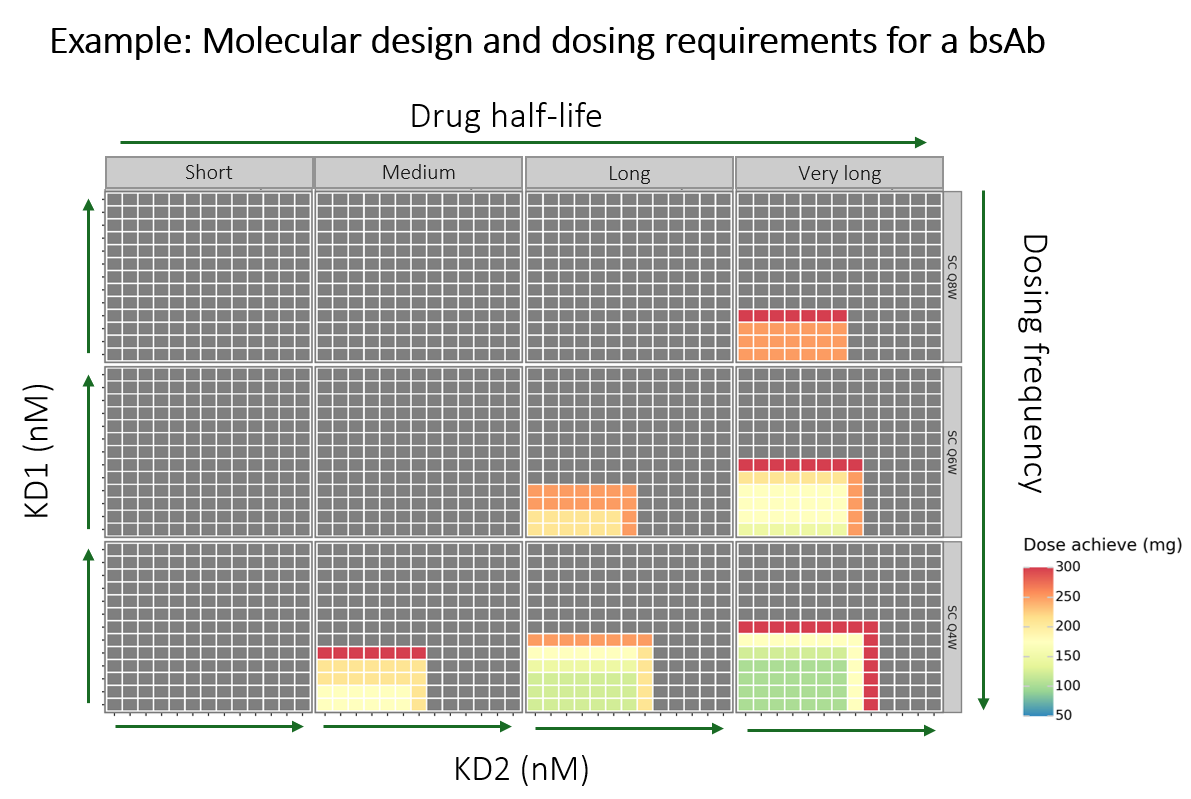
  • Affinity and half-life design space mapping
  • Valency and format trade-off analysis (e.g., 1×1 vs. 2×2 bispecifics)
  • Dosing route/interval feasibility (e.g. SC vs. IV, Q4W vs. Q8W)
Heatmap of molecular design and dosing requirements for a bispecific antibody (bsAb)
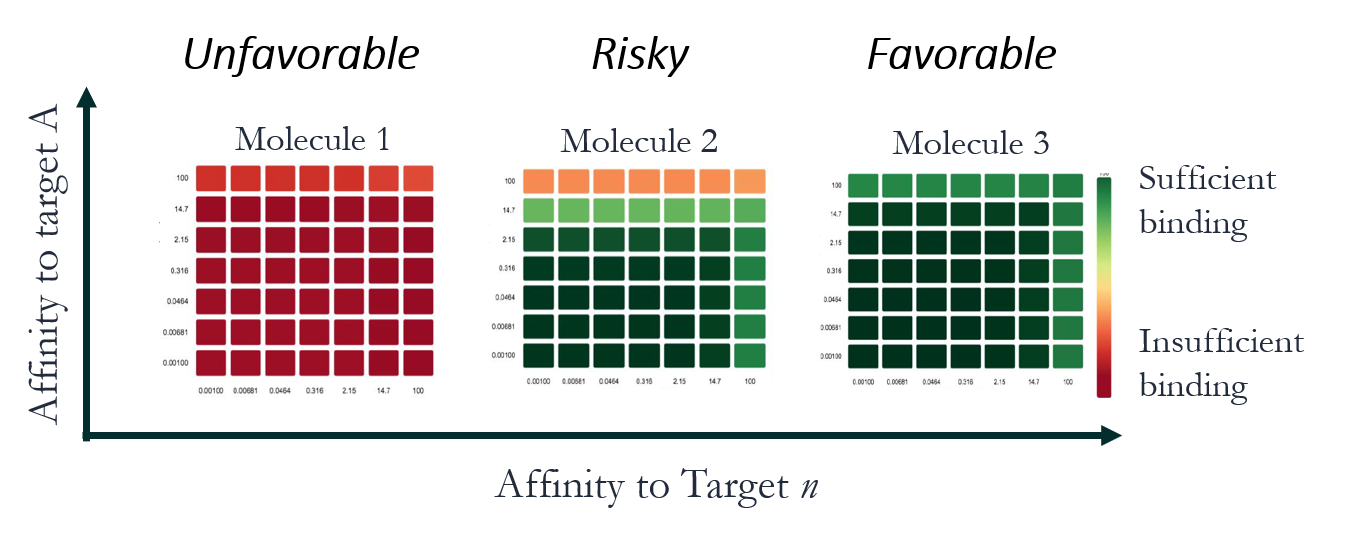
Antibody affinity heatmaps comparing unfavorable, risky, and favorable target binding profiles

2. Lead candidate selection

When multiple drug concepts or molecules are under evaluation, EFA provides an objective, pharmacology-based ranking. Candidates are assessed against developability criteria, distinguishing the most favorable from the infeasible, and highlighting which molecules carry the greatest risk before committing resources to their production.

  • Candidate triage based on predicted in vivo target engagement
  • Developability ranking (most favorable → infeasible)
  • Competitor benchmarking and differentiation analysis
  • Context-dependent pharmacology assessment (e.g., TMDD, masking)

3. Portfolio prioritization

EFA scales to portfolio-level decision-making, making portfolio prioritization achievable for pharma sponsors of any size, triaging dozens of drug concepts simultaneously. By simulating millions of parameter combinations, affinities, half-lives, valencies, dosing regimens, across entire portfolios, EFA provides a rational basis for resource allocation before any molecules are produced.

  • Industrial-scale biosimulation across large candidate sets
  • Go/no-go recommendations based on pharmacological and developability evidence
  • Integrated clinical evidence assessment per concept
  • Pivot planning when lead concepts underperform
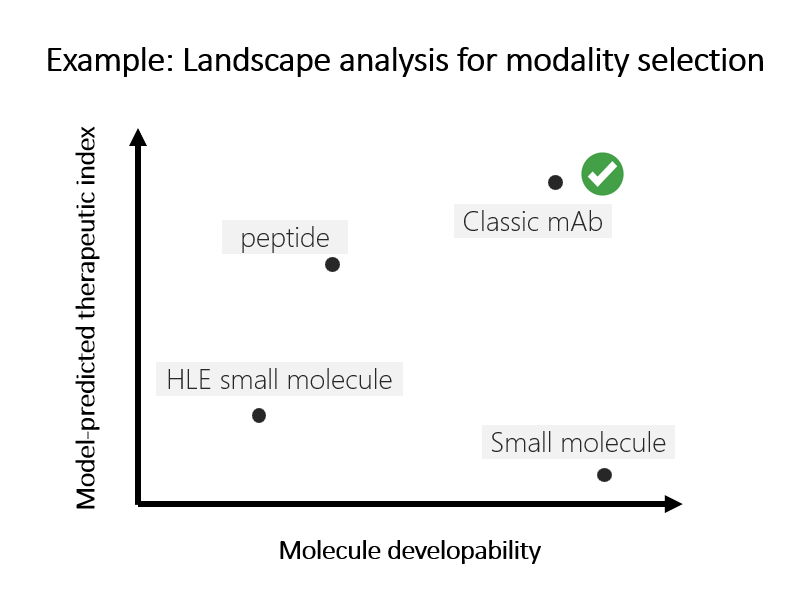
Landscape scatter chart comparing drug modality developability and therapeutic index

4. Modality selection

Choosing the right drug modality – monoclonal antibody, bispecific, ADC, T-cell engager, or degrader – is a critical early decision that profoundly shapes PK, safety, and manufacturing complexity. EFA uses mechanistic models to compare modalities head-to-head on their predicted in vivo pharmacology, enabling evidence-based format selection before platform investment.

  • Comparative in vivo pharmacology across modality formats
  • Assessment of complex mechanisms: masking, conditional activation, avidity
  • Bispecific, multispecific, and novel modality feasibility
  • Therapeutic index evaluation by format

5. Animal study design optimization

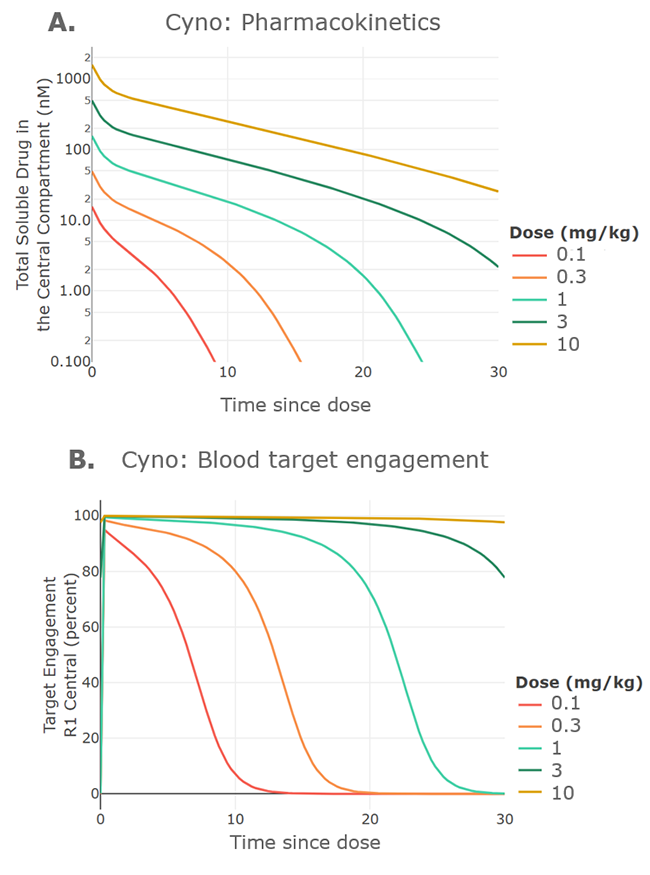
EFA directly supports the 3Rs (Replace, Reduce, Refine) in nonhuman primate (NHP) and other animal studies by using simulation to inform dose selection, interval, and sample collection timing, before any animals are used. Mathematical modeling can predict which dose levels and time points will yield the most valuable pharmacokinetic and pharmacodynamic information, enabling more efficient study designs that use fewer animals without sacrificing scientific value.

By simulating PK and target engagement profiles across candidate dose levels, teams can plan studies that distinguish TMDD from linear PK, optimize sampling schedules to capture key transitions, and avoid redundant dose groups that provide limited additional information.

Cynomolgus monkey pharmacokinetics and target engagement charts across antibody dose levels

Committed to the 3Rs? Go further with Non-Animal Navigator™

EFA’s simulation-driven approach to animal study design pairs naturally with Certara’s Non-Animal Navigator™, a solution purpose-built to help sponsors reduce reliance on animal testing across development. Explore how it complements your EFA workflow.

Certara IQ™ Explore — purpose-built for discovery-stage QSP

EFA is delivered using Certara IQ™ Explore, a QSP software platform with pre-built and validated mechanistic model packs covering a broad range of biologic modalities. The platform enables rapid simulation deployment—critical when time to actionable results is measured in weeks, not months.

  • Pre-built, validated model packs for diverse biologic modalities
  • Industrial-scale simulation capacity
  • Instant visualization of PK, target engagement, and feasibility outputs
  • Models are reusable as new questions arise throughout discovery
  • Available as licensed software or as a Certara-led consultancy engagement
  • Option for custom model delivery within Explore

QSP 卓越中心

依托 Certara QSP 团队解答关于靶点优先排序、 剂量确定、 疗效或毒性评估、市场竞争地位分析等关键问题。

与 QSP 专家合作

350

年累计经验

275

家客户

700

个 QSP 项目

70

位 QSP 科学家

Ready to evaluate your biologic’s pharmacological feasibility?

Talk to a Certara QSP expert to discuss how Early Feasibility Assessment can be applied to your discovery program, whether you are conducting target identification and validation, pursuing lead optimization in drug design, or handling portfolio prioritization for your pharma organization.


沪ICP备2022021526号

Powered by Translations.com GlobalLink Web Software