


跳转到主要内容
搜索

Chemaxon Descriptor Generation Toolkit

Chemistry calculators for increasing certainty in drug discovery

Descriptor Generation Toolkit

Assessing compounds in-silico is the most efficient way to prioritize new ideas, making sure only the best options are pursued and so minimizing effort spent on less promising compounds.

The Descriptor Generation Toolkit gives you the scientifically accurate property predictions needed to achieve this. It also allows you to generate the descriptors needed to thoroughly characterize the structures to train new models on your data.

Descriptor Generation Tools

hERG Inhibition

Optimizing ADMET predictions, pharmacokinetics and toxicity attributes are profound goals across all drug discovery projects. Exploit the power of machine learning methods on curated data sets to support the drug design and medicinal chemistry optimization with reliable models and predictions, targeting the elimination of cardiotoxicity risk during drug discovery.

  • Continuous affinity prediction (pActivity=-log(Activity)) and classification
  • State-of-the-art conformal prediction framework for error estimation
  • Domain of applicability assessment: report on the top 5 most similar training data points
  • Extendability: model can be re-trained with in-house data

Elemental Analysis

Elemental Analysis provides fundamental molecular properties for general chemistry workflows and analytical scientists.

  • Exact and nominal mass, molecular weight and atom count
  • Elemental composition
  • Molecular formulae
  • Molecular composition
  • Mass spectrum (isotope distribution) calculation

Partitioning

The partitioning of drugs in microscopic environments (e.g.: lipid bilayers of biological membranes) of different lipophilicity and hydrophilicity heavily influences its pharmacokinetic behavior. The partitioning is described by the logP and logD values of a drug, which are major descriptors in predicting ADMET properties.

The Partitioning calculator provides:

  • LogP values using scientifically sound methods – LogP documentation
  • LogD (pH vs. logD) plot – LogD documentation
  • HLB (Hydrophilic Lipophilic Balance) number

Solubility

Solubility in water (commonly referred to as logS) is one of the most important parameters to achieve for desired pharmacological response. Any drug to be absorbed must be present as a solution at its site of absorption.

As the majority of drugs are molecules that have ionizable groups, the solubility of the compound depends highly on the pH environment. The Solubility Predictor is able to predict:

  • Intrinsic (thermodynamic) solubility in water
  • pH-dependent solubility (pH-logS plot)
  • A qualitative solubility category

NMR Predictor

Nuclear Magnetic Resonance spectroscopy is the primary experimental technique to confirm and determine the chemical structure of organic compounds.

As NMR spectrometers are relatively expensive, predicting NMR spectra for a set of possible structures and comparing them with experimental data is a well established approach to facilitate structure elucidation. The NMR Predictor is able to:

  • Predict 13C and 1H NMR spectra for molecules composed of the most frequent elements (H, C, N, O, F, Cl, Br, I, P, S, Si, Se, B, Sn, Ge, Te and As)
  • Import and display NMR spectra from JCAMP-DX files

Structural Calculations

Structural Calculations provide:

  • Hydrogen Bond Donor/Acceptor (HBDA) count
  • 2D topological descriptors
  • 3D geometrical descriptors
  • Molecular surface calculations
  • 3D conformer generation, molecular dynamics
  • 3D Alignment
  • Different electron structural property calculations

Isomers

The ability to deal with molecular structures that have identical atomic composition, but different arrangement of bonds or spatial orientation is crucial in the identification, search and property calculation of compounds. Tautomerism, stereoisomerism and resonance are examples of isomerism.

Tautomerization can affect identification, searching and physico-chemical properties of molecules. Stereoisomers have the same physico-chemical properties (e.g.: melting point, solubility), but they differ in pharmacokinetic and pharmacodynamic behavior. Resonance describes the rearrangement of delocalized electrons in the molecule, which results in a set of contributing structures of the original structure.

The Isomer calculator can:

  • Generate different tautomer sets useful for searching and tautomer handling
  • Calculate tautomer distribution and major tautomer form in water
  • Generate tetrahedral and double-bond stereoisomers starting either from a 2D or 3D structure
  • Generate resonance structures

Protonation

Ionization has an essential impact on compound behavior in nearly all protic environments. On top of its application in general and analytical chemistry, relationships to drug pharmacokinetics and pharmacodynamics are well-established. Acidic and basic dissociation constants (pKa) and the microspecies distribution at different pH values are important to quantitatively describe ionization and comprehend physical and biological processes.

The Protonation calculator includes:

  • Highly-accurate calculation of pKa values along with pH dependent distribution plots of relevant microspecies in water – pKa documentation
  • Calculation of the major microspecies form at a given pH value – Major microspecies documentation
  • Isoelectric point calculation

Availability

The Toolkit bundles are built to easily integrate with most systems using a range of different APIs including Java, Python, Microservices and .NET.

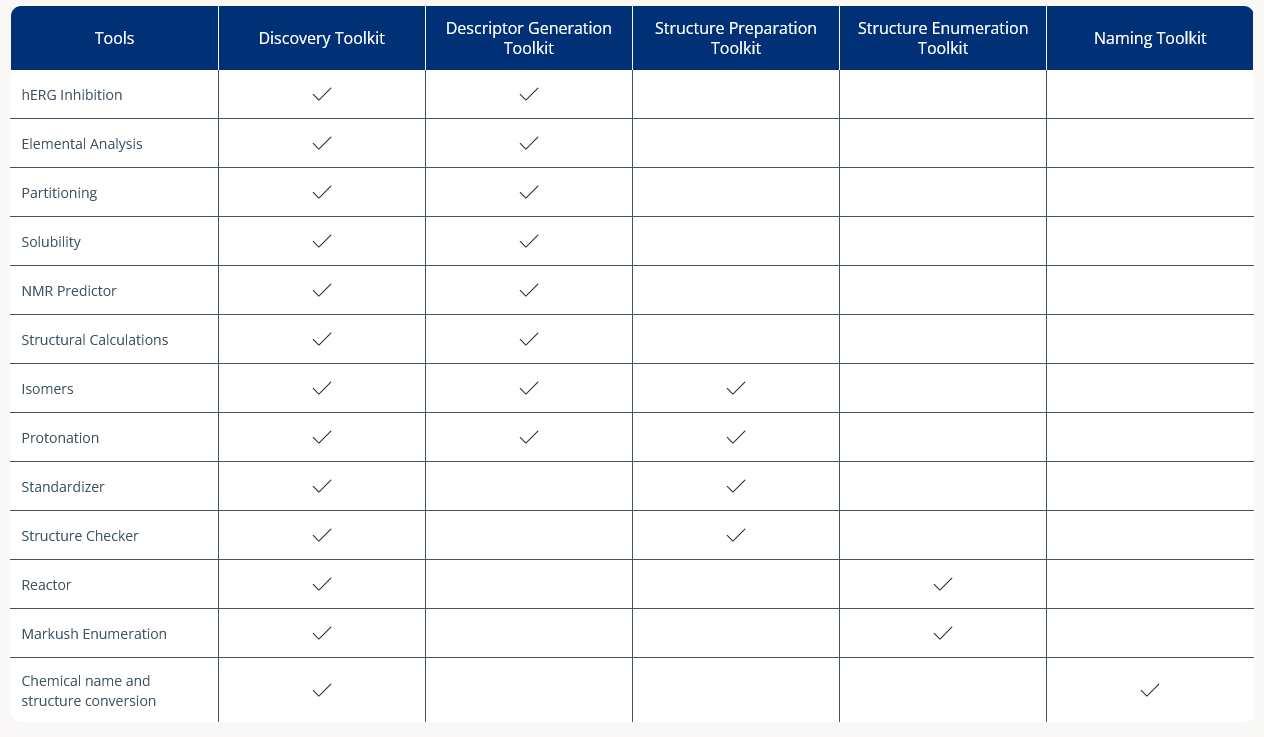
Toolkit Offerings

Tools Discovery Toolkit Descriptor Generation Toolkit Structure Preparation Toolkit Structure Enumeration Toolkit Naming Toolkit
hERG Inhibition

×

×

×

Elemental Analysis

×

×

×

Partitioning

×

×

×

Solubility

×

×

×

NMR Predictor

×

×

×

Structural Calculations

×

×

×

Isomers

×

×

Protonation

×

×

Standardizer

×

×

×

Structure Checker

×

×

×

Reactor

×

×

×

Markush Enumeration

×

×

×

Chemical name and structure conversion

×

×

×

Workflow-Specific Toolkits

Our workflow-specific offerings are designed to serve your needs with a targeted subset of tools bundled together.

Discovery Toolkit

查看详情

Structure Preparation Toolkit

查看详情

Structure Enumeration Toolkit

查看详情

Naming Toolkit

查看详情

With Discovery Toolkit, your data is secure

Certara 信息安全管理体系(ISMS)已通过 ISO 27001 认证。我们已实施严密的安全控制措施,完成严格的风险评估,并持续改进。Discovery Toolkit ensures full compliance with global data protection standards, offering peace of mind for sensitive analysis.

了解更多信息,请访问我们的信任中心

为什么选择 Certara?

Certara 提供尖端解决方案,赋能科学家基于数据驱动决策,加速药物研发进程并提升成果产出。

早期药物发现是 Certara 核心专业领域,由该领域资深权威专家团队提供技术支持
来自药物研发界的活跃用户社群,驱动我们持续优化解决方案,满足创新研究的动态需求

Using Chemaxon’s suite of tools as core components of our chemistry workflows, they save us time while supporting strong, science-driven decisions. What sets them apart is that their team is professional, approachable, and genuinely invested in helping us succeed.

Xin Zhang
Sr. Director, Cheminformatics and AI/ML
Cellarity

预约演示

Discovery Toolkit contains every cheminformatics toolkit we have to offer.

For more specific needs, we offer workflow-specific bundles:

Descriptor Generation Toolkit
Structure Preparation Toolkit
Structure Enumeration Toolkit
Naming Toolkit

Reach out to us

– Leave your contact information
– Summarize what you are looking for
– Our colleagues will get back to you soon


沪ICP备2022021526号

Powered by Translations.com GlobalLink Web Software