


跳转到主要内容
搜索

2026 年 4 月 23 日

Physiologically based pharmacokinetic (PBPK) modeling has evolved from an emerging methodology into a standard part of regulatory submissions. Today, platforms like Simcyp® Simulator play a critical role in model-informed drug development (MIDD), supporting decision-making across the drug development lifecycle. If you’re evaluating PBPK tools, this article explores the top 10 benefits of Simcyp Simulator and why it has become the industry standard.

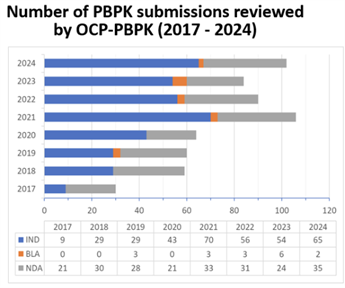
Reviews by the FDA Office of Clinical Pharmacology show consistent use of PBPK modeling across IND, NDA, and BLA submissions, highlighting its growing role in regulatory decision-making (Figure 1). Drug-drug interaction (DDI) assessment remains the most common application, followed by evaluations in specific populations, such as pediatrics and patients with organ impairment, as well as formulation-related applications such as food-effect assessment and bioequivalence (Figure 2).

Figure 1. Number of PBPK submissions reviewed by OCP-PBPK (2017-2024) Source: Yuching, et al., DDI Marbach Workshop 2025
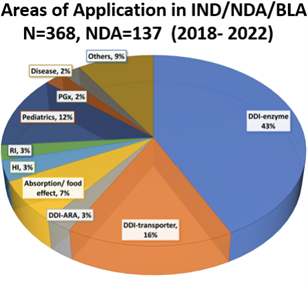
图 2. PBPK Areas of Application in IND/NDA/BLA submissions reviewed by the FDA OCP (2018-2022) Source: Yuching, et al., DDI Marbach Workshop 2025

As regulatory expectations continue to evolve, PBPK modeling is increasingly being used in place of certain clinical studies. To date, more than 120 FDA-approved novel drugs have used Simcyp® Simulator for PBPK modeling in lieu of clinical studies, and 80% of recent FDA-approved novel drugs leveraging PBPK used Simcyp. In August 2025, Simcyp Simulator became the first and only software platform to earn EMA qualification following an extensive collaborative engagement between Certara and the EMA.

Available through software licensing or tech-backed consultancy, Simcyp continues to set industry and regulatory benchmarks as a leading global PBPK modeling platform.

The following are the top 10 benefits of Simcyp Simulator:

1. Reduce or replace clinical studies

Use PBPK modeling to reduce development timelines and costs by minimizing the need for certain clinical trials.

2. Make better early-stage decisions

Perform first-in-human (FIH) PK/PD predictions earlier to triage compounds and focus resources on candidates with the highest probability of success.

3. Design more efficient clinical trials

Support dosing selection and optimize trial design to reduce unnecessary study burden and improve development efficiency.

4. Extend insights to untested populations

Bridge existing data to populations that are difficult to fully study clinically, such as pediatrics, pregnancy, lactation, patients with organ impairment, and individuals with genetic polymorphisms.

5. Optimize formulations faster

Evaluate alternative formulations in silico to accelerate optimization without additional clinical studies.

6. Enable biowaivers and virtual bioequivalence

Support biowaivers and virtual bioequivalence (VBE) for complex generics using a validated PBPK platform.

7. Support decisions across the full development lifecycle

Use one consistent modeling platform from pre-IND through post-marketing to inform key development decisions.

8.Use a platform recognized by regulators

Simcyp Simulator is the first and only PBPK modeling platform qualified by the EMA and is trusted and used by more than 10 global regulatory agencies.

9.Explore critical what-if scenarios

Address critical “what-if” questions with confidence and support stronger NDA and BLA packages.

10. Build on a strong scientific foundation

Leverage an extensive scientific foundation, supported by leading experts, including several among the world’s top 2% most cited researchers.

Most importantly, Simcyp Simulator helps bring medicines to patients faster while improving return on investment through smarter compound selection, fewer clinical studies, and more informed decision-making.

Join a community of scientists using Simcyp to accelerate drug development.


This blog was originally published in June 2021 and has been updated for accuracy.

Author

Xian Pan, PhD

Principal Scientist, Certara

Dr. Xian Pan is a Principal Scientist at Certara Predictive Technologies. She received her BSc in Pharmacy and an MSc in Pharmacokinetics from China Pharmaceutical University and earned a Ph.D. in Biopharmaceutical Sciences from the University of Illinois at Chicago. Her doctoral work focused on understanding the altered pharmacokinetics during pregnancy, specifically investigating the molecular mechanisms of CYP2D6 induction and interindividual variabilities. She has worked in the industry as a Senior Research Scientist, leading and managing preclinical DMPK projects from drug discovery to IND filing. Since joined Certara Predictive Technologies in 2017, she has significantly contributed to PBPK framework enhancement, including various modules’ development and expansion for small molecule drugs and therapeutic proteins, and evaluation of drug-drug interaction liabilities for both modalities. She has actively contributed to the expansion of the virtual populations for pediatrics, premature neonates, and fetus. She has several publications in the field and provided training and consultancy for a number of pharmaceutical companies.

Supporting PBPK applications across drug development

Simcyp offers a comprehensive suite of PBPK modeling solutions. Learn how Simcyp can support your MIDD strategies.

了解更多关于 Simcyp

值得信赖的 PBPK 建模平台

预约演示或咨询,了解 Simcyp 如何为您的团队赋能

已验证的成功案例: 120+ 种创新药物通过 Simcyp PBPK Simulator 替代临床试验
科学专业积淀: 历经 25 年持续迭代,整合 37 家全球顶尖药企的专业技术积累

全球监管认可: 获得 11 个全球监管机构的授权许可

沪ICP备2022021526号

Powered by Translations.com GlobalLink Web Software