


跳转到主要内容
搜索

2026 年 5 月 12 日

Pharmaceutical market access, sales, and field teams rely on high-quality, effective content to demonstrate their products’ value globally. As companies expand internationally, effectively rolling out content that meets global and local needs becomes challenging. These materials typically include

  • value dossiers, which present comprehensive evidence of a product’s clinical and economic value
  • budget impact models that help stakeholders evaluate the financial implications of adopting a product
  • health economics and outcomes research (HEOR) tools
  • promotional materials and educational resources tailored to specific audiences

These diverse content types are vital in supporting your pharma commercialization strategy. Collectively, they inform reimbursement discussions and drive sales initiatives in the complex and competitive pharmaceutical landscape.

The need for localized evidence, varying product approval timelines, and regional regulatory requirements often complicate the process. Additionally, ensuring content is easily and accurately translated is essential to reaching audiences in different languages and regions. This blog will explore the challenges in international content roll-out. We’ll also share best practices to help pharma teams navigate these complexities.

Key challenges in pharma commercialization

1. Global content vs. local relevance

  • Regional teams are often concerned that materials created by global teams lack local relevance. Global teams may not incorporate country-specific data, regulatory requirements, or market nuances in their content. Materials that miss this localized focus may not resonate with healthcare providers, payers, and other key stakeholders.
  • Local market needs often include:
    • evidence that aligns with regional health economic data,
    • local case studies, or
    • culturally relevant messaging.

When you don’t localize content in pharma, even well-designed materials may struggle to have impact.

2. Varying product approval timelines

  • Pharma products often receive staggered approvals across different countries. This creates unique challenges in content management. For example, one country may approve a product for a specific indication. However, a product may still be awaiting approval for the same or a different indication in another country.
  • Such variations mean that materials must adapt to each product’s precise regulatory and approval status in each market. Content must be flexible so regional teams can adjust it without compromising its integrity.

Being able to localize content in pharma forms a vital part of any successful commercial launch strategy.

3. Need for interactive value tools to enable adaptability & seamless translation

  • Global teams need tools that allow regional markets to easily localize content in pharma. This could include translating materials accurately and efficiently. Without the right technology, the customization process—including translation—can become lengthy, labor-intensive, and resource-intensive. An inefficient customization process delays content reaching the field.
  • Tools like BaseCase support flexibility by enabling translation-ready modular content. Using it allows field teams to make quick, compliant adjustments for each language or region. This capability is essential for making materials accessible to diverse audiences without compromising consistency.
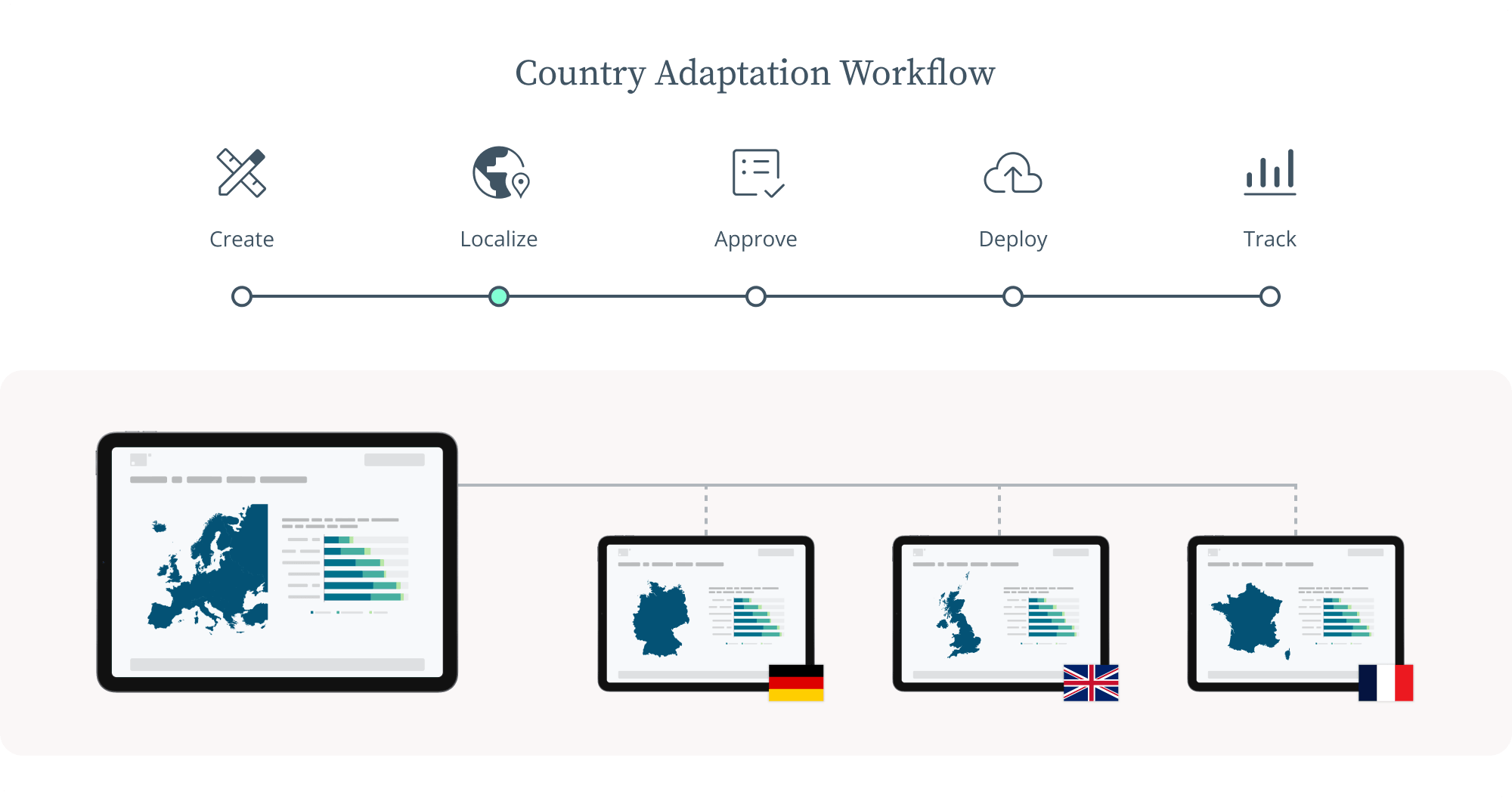
Country adaptation workflow showing steps (Create, Localize, Approve, Deploy, Track) with dashboards customized for Germany, UK, and France.

4. Limited early input from local teams

  • When local teams are not involved early in the content creation process, important regional considerations can be overlooked. Global teams may aim to provide universally relevant materials. However, these materials often miss nuances that could have been integrated if they involved regional representatives from the beginning.
  • Early engagement with local teams can help capture local data needs, regulatory constraints, and messaging preferences. This approach makes it easier to localize content in pharma from the outset. Additionally, involving local experts in reviewing translations ensures accuracy and relevance, especially for specialized medical or market access terminology.

Best practices for pharma commercialization in market access

1. Create a flexible, translation-friendly modular content framework

  • Global teams should develop a modular approach to content. Provide core materials that sponsors can adapt to meet regional needs, including translation requirements. This involves creating widely relevant baseline assets. Include space for local evidence, regulatory information, and language adjustments.
  • Prepare content with translation in mind. Using clear, consistent language and avoiding idioms can minimize ambiguity when adapted to local languages. This approach saves time, reduces duplication of effort, and ensures that materials stay compliant and aligned across regions.

2. Invest in technology to streamline adaptability and translation

  • Implementing digital tools that facilitate both content customization and translation is essential for global roll-outs. Platforms like BaseCase provide built-in flexibility, allowing regional teams to quickly adapt global materials and localize content in pharma with minimal resources.
  • By leveraging translation management features, field teams can ensure accurate and efficient translations that maintain the core content. Some platforms allow for translation memory, helping ensure that medical terminology and brand-specific language stay consistent across languages.

3. Collaborate early with local teams

  • A best practice in the international roll-out process is to involve local teams early in the development stage. By including representatives from key regions, global teams can gather essential insights into regional regulations, healthcare practices, and audience preferences.
  • This early collaboration helps create content that aligns with local needs. It also reduces the amount of rework required during content roll-out.
  • Moreover, involving local teams promotes greater buy-in and engagement. This approach helps them feel that their insights are valued and considered. Local team involvement is especially useful in ensuring translations are technically accurate and aligned with local conventions.

4. Enable version control and approval tracking

  • Managing multiple versions of content for different markets can be challenging. This is particularly true when regulatory changes or new evidence requires updating content. Have a centralized version control system that allows teams to track revisions and ensure that they use the right version in each market.
  • Such a system can help teams manage approvals more efficiently. This approach also ensures that local adaptations of global content comply with relevant regulations, while keeping stakeholders updated.

5. Encourage a continuous feedback loop

  • After roll-out, create channels for ongoing feedback from local teams to help identify what works and what doesn’t. Understand how healthcare providers, payers, and other stakeholders receive content to enable continuous improvement.
  • Regular feedback from local markets also allows global teams to refine future materials. This will ensure that each successive roll-out is better tailored to meet diverse market needs.

Summary and next steps

Effective pharma commercialization in market access requires balancing global consistency with local relevance. Mere content adaptation isn’t enough. It also requires a thoughtful approach to translation.

By making content translation-friendly, leveraging adaptable digital tools, and involving local teams, companies can ensure that their materials resonate across languages and cultures. Implementing a modular content framework, leveraging adaptable digital tools, involving local teams early, and fostering continuous feedback are all critical steps to success.

With these best practices, global and local teams can work seamlessly together and easily localize content in pharma. Follow them to deliver high-impact content that resonates with audiences worldwide, while supporting business goals.

Author

Daria Lavrentev

Product Manager

Daria Lavrentev is a Product Manager at Certara for the BaseCase software team. She earned a master’s degree in economics from the University of Freiburg in Germany and a bachelor’s degree in applied mathematics from the Technion-Israel Institute of Technology.

This blog was originally published in January 2025 and has been updated for accuracy.

常见问题解答

What are the key challenges in international pharma marketing during a global rollout?

International pharma marketing often faces challenges, such as regulatory variability, language differences, and inconsistent brand positioning across regions. Teams must coordinate across markets while maintaining compliance and speed. Integrating localization early and building a scalable pharma commercialization framework helps reduce delays and ensures cohesive messaging throughout the rollout process.

Why is localization critical to pharma commercialization success?

Effective pharma commercialization depends on delivering relevant, compliant messaging to each target market. When companies localize content in pharma, they improve engagement with healthcare professionals and patients while reducing regulatory risk. Localization ensures that global strategies translate into meaningful local execution, which is essential for adoption and long-term product success.

How can companies effectively localize content in pharma for global markets?

To successfully localize content in pharma, companies must go beyond translation and adapt messaging to cultural, regulatory, and clinical nuances in each market. This includes aligning with local healthcare systems, patient expectations, and compliance standards. A strong localization approach is critical for successful international pharma marketing, ensuring messaging resonates while maintaining scientific accuracy and brand consistency.

How does an EU pharma strategy differ from other regional approaches?

An effective EU pharma strategy must address the region’s complex regulatory landscape, diverse healthcare systems, and multilingual audiences. Compared to other markets, it often requires deeper coordination and earlier planning within a pharma commercial launch strategy. Tailoring approaches for the EU is essential to ensure compliance, streamline approvals, and support broader pharma commercialization goals.

What should be included in a pharma commercial launch strategy for multiple regions?

A strong pharma commercial launch strategy should include early planning for market access, localized messaging, stakeholder alignment, and regulatory approval timelines. For global success, it must integrate EU pharma strategy considerations alongside other regional requirements. This ensures that launch activities are synchronized and adaptable, maximizing impact across diverse healthcare environments. Read this blog to further your knowledge and learn our top 5 recommendations for successful interactive value messaging

Make an inquiry

Ready to bring your value story to life? Make an inquiry to learn how BaseCase value communication software transforms complex economic models and clinical data into interactive, field-ready tools.

Show live impact with real-time scenario updates
Show budget impacts and cost-effectiveness with live cost calculators
Adapt by audience without rebuilding models
Ensure compliant consistency across teams


沪ICP备2022021526号

Powered by Translations.com GlobalLink Web Software