



跳转到主要内容
搜索

2026 年 9 月 29 日

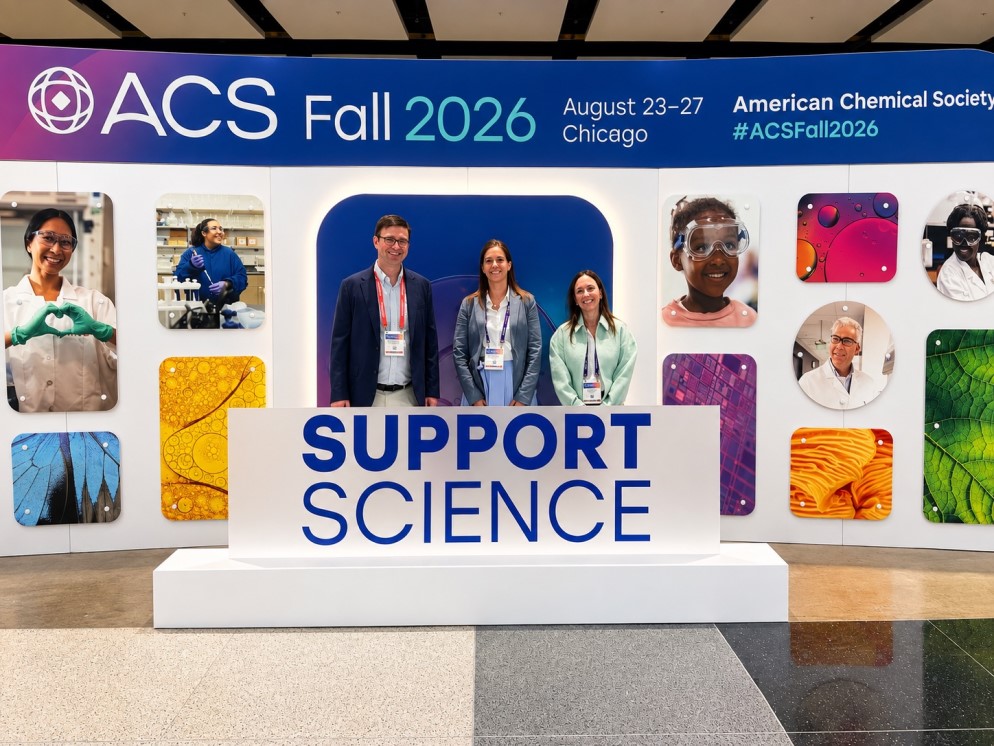
The American Chemical Society’s national meetings are the best opportunity to stay on top of inspiring discoveries and how chemists are performing science in an evolving landscape. Recently I joined Certara colleagues for the ACS Fall 2026 meeting in Chicago, where cheminformatics trends in 2026 were on full display. The week was full of great science at talks and in the poster sessions, plus plenty of conversation with a diverse group of chemists in the Exposition Hall. One thing became clear over the course of the event: AI is changing how chemists are working. Here’s what stood out.

Working together with AI

Almost everyone discussed using AI in their workflow. What was interesting is the variety of ways people were using AI, which included automating literature research, designing compounds, predicting reaction performance, performing experiments, automating chemical analysis, and more.

For medicinal chemistry and iterative design problems, SHEO Pharma’s Gui-Bai Liang’s experience was representative. His team let AI systems suggest compounds to synthesize, but they always added another 25% to diversify the set. He offered a simple suggestion for working with AI, “Just ask ChatGPT those questions!”In his experience, the right phrasing was useful, and he credited AI for helping break through their oral bioavailability challenge in developing new drugs for resistant hypertension.

Thursday’s session on agentic AI workflows showcased the variety of ways that AI can impact the drug discovery process in addition to compound design. One of the intensive parts of discovery is researching prior work. Even skilled chemists need significant time to find publications, read, comprehend, and summarize the state of the field to make decisions about designing compounds. Both Paramus AI and OnePot.AI use AI for that research, and both noted the need and value of an expert human to review the results and design experiments. OnePot.AI aims to go much further, building toward a fully automated, AI driven custom synthesis shop. While they are working on challenges in physically running experiments, they are also building new AI agents for the more banal tasks in synthetic chemistry such as purchasing, logistics, and compliance. I think most synthetic and medicinal chemists would love to have those tasks simplified or outright removed from their workdays.

Human intelligence is still important

Despite the promise and potential of AI, a common theme was that humans still need to be in the loop. Expert review of AI’s returns is valuable. Digital Science lets AI handle the grunt work of finding biochemical reactions in the literature to populate reaction databases. LLMs often hallucinate on chemical and biological details, and Digital Science cautioned that even with prompts carefully written to minimize hallucinations, the agents can return problematic results. They are working to include human-inspired verification (confirm that reactions are balanced; attempt to map atoms from reactants to products), but in the interim, expert review seems prudent. Another common theme through the conference was that guardrails are necessary. I imagine that this will be an increasing area of emphasis. I’ve found that the best scientists admit when they don’t know, and perhaps that needs to be a reasonable answer from an AI agent also.

With those thoughts in mind, as with any tool, the judicious chemist will decide when to trust AI and when to be skeptical. Every research group and organization has its strengths and weaknesses. Ultimately, it will be up to synthetic and medicinal chemists to decide where AI best fits into their workflows to move projects forward.

As long as humans are in the loop, chemists need to draw

Our focus for the week at the Certara booth was Marvin Cloud, which delivers our premier chemical drawing application directly to users by subscription. ACS brings a cross section of chemists together unlike any other conference. Of course, academia was well represented, with professors, instructors, and students of all levels. Industrial chemists spanned pharma, biotech, agriculture, materials, and beyond. Visitors to our booth were tested with the Marvin pKa challenge, and similarly visitors put Marvin to the test. Gratifyingly, users were able to easily start drawing structures and reactions. From there a typical conversation went like this:

“What else can it do?”

We showed off some of Marvin’s primary tools like calculations, style settings, and the universal search bar. But some simple quality of life features such as the symbol text menu proved to be big hits too. No more copying and pasting from some other document or using a superscript “o” for a degree symbol!

“Can I edit a figure embedded in Word?”

Yes, you can open Marvin drawings from Word and Powerpoint and return changes to the Office document.

“Even on a Mac???”

Sigh, not on a Mac. That’s a Microsoft issue, not a Marvin issue, but we feel your pain. We keep looking for a solution to that one.

Even with the utility of AI increasing by the day, the ACS Meetings show that effective communication to humans remains a critical piece of science. We hope that you will give Marvin a try and see if it can help you build clear, visually appealing figures for your next presentation.

Author

Jeremiah Malerich, PhD

Solution Consultant

Dr. Jeremiah Malerich is a Solution Consultant working in the Discovery Portfolio of Certara. He joined Chemaxon – acquired by Certara in 2025 – two years ago after a long career in the CRO business supporting drug discovery programs. In his previous life, he saw how critical robust cheminformatic tools were to the success of programs, and he now brings that experience to Certara and its partners. His background is synthetic organic chemistry with a PhD from the University of California, Berkeley.

沪ICP备2022021526号

Powered by Translations.com GlobalLink Web Software